

The Push for Real Time Score Inquiries in Figure Skating
As calls grow for real-time score challenges, the ISU says it continues to review the system — but is not committing to change.

From gymnastics to artistic swimming, to diving and even Major League Baseball, sports across the Olympic and professional landscape have taken advantage of new technology over the years to incorporate real-time reviews and/or score inquiries into their systems.
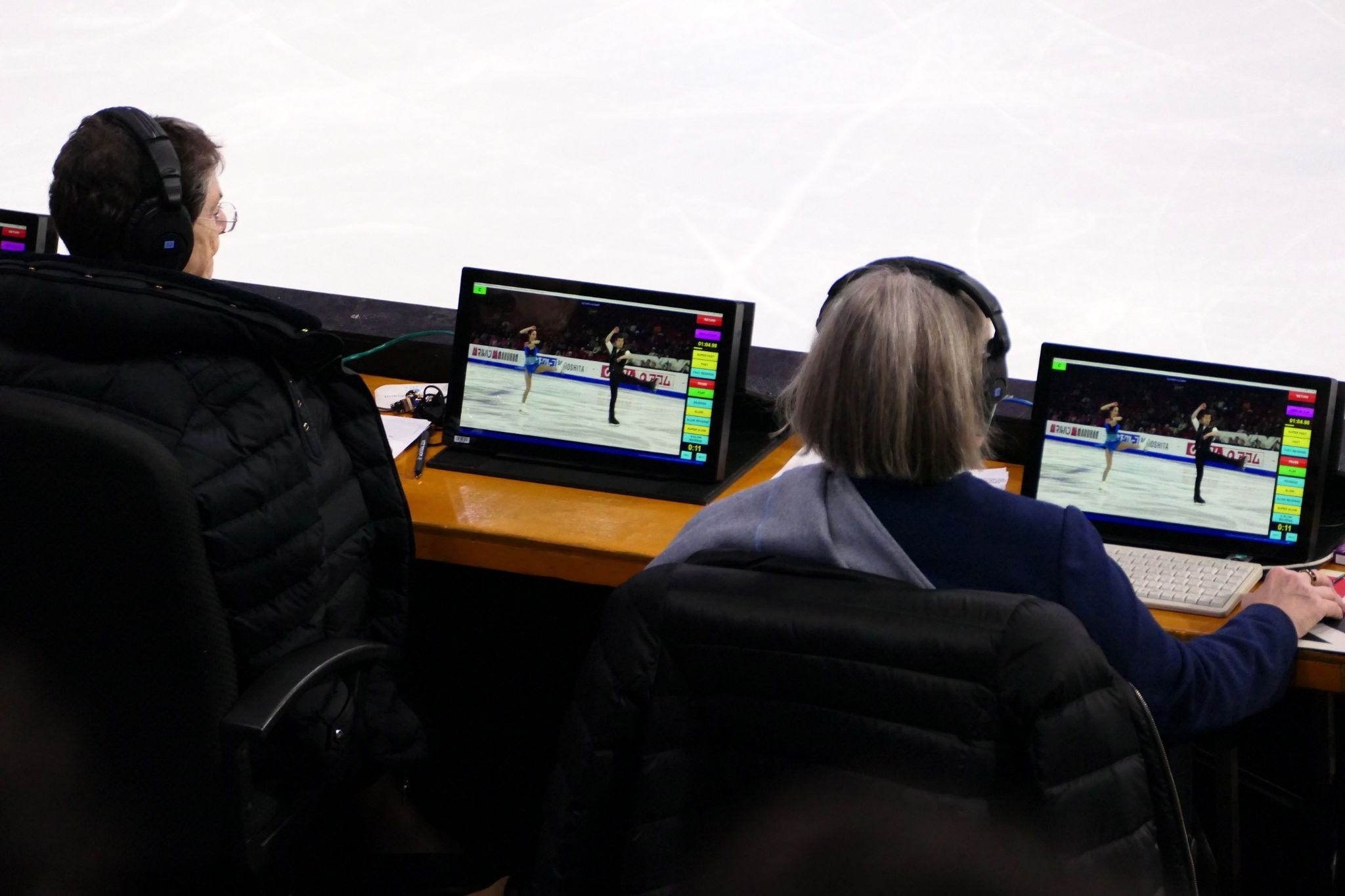
Figure skating has also seen a major overhaul of its judging system, which now allows judges to use replay technology to score levels and evaluate the execution of elements. But it remains one of the only major judged sports where athletes or coaches themselves have virtually no ability to formally challenge a score or technical call in real time.
Following a 2025-26 season that saw more than its share of judging controversy — from a widely debated illegal element call in ice dance to a quad twist entered incorrectly as a triple — skaters and coaches are calling on the International Skating Union (ISU) to introduce a way to immediately inquire about or appeal potential scoring errors, with many telling Broken Ice they have actually been advocating for the change for years.
Despite growing frustration inside the sport, the ISU told Broken Ice that a Council meeting later this month will discuss rule changes and updates for next season. However, it stopped short of committing to any changes regarding score inquiries or appeals.
“The ISU continues to build on a robust judging and scoring framework, which is regularly reviewed and progressively developed through ongoing dialogue and close consultation,” an ISU spokesperson said.
“In parallel, the ISU is focused on providing officials with the appropriate tools, guidance, and support necessary to perform their duties at the highest level.”
“The athletes have to have some agency”
Currently, the ISU rules state that “Protests against results are permitted only in the case of incorrect mathematical calculation. A wrong identification of an element or of a level of difficulty, although it results in a lower or higher score is not an incorrect mathematical calculation.”
Protests must be filed in writing with the Referee within 24 hours of the competition ending, along with a 100 Swiss Franc fee (approximately $175 CAD or $127 USD). The fee is refunded if the protest succeeds; otherwise, it is remitted to the ISU.
The referee can also correct errors if they become aware of a data input error prior to the awards ceremony or up to 24 hours after the awards ceremony for a mathematical error - even without a protest being filed.
“Field of play decisions” — such as scores or times (for speed skating) announced during competition — are considered final and cannot be reviewed or changed, except in limited cases involving successful formal protests, according to ISU rules.
Despite the written rules, International Ice Dance coach Carol Lane says protests are virtually impossible.
“It almost never happens., she said. “It’s very arcane…You trying to protest a call pretty much has no chance of success.”
Lane says she has repeatedly raised the issue of a score inquiry or challenge in real time for years.
“I’ve actually said this to multiple people at multiple times, including the ISU,” she told Broken Ice. “I think that we definitely need an athlete-centered protest system… The athletes have to have some agency. At the moment, they have none. And that’s not healthy.”
Lane envisions something similar to tennis challenges — one carefully limited protest per program.
In her proposal, a challenged element would be reviewed by an independent off-site technical panel that would only see the isolated element in question.
“At the moment the system is entirely set up to show that the officials are always right and the athletes and coaches are always wrong,” she said. “And that’s not true. Sometimes it’s true… But it would at least give you some control because right now there’s none.”
Lane acknowledged that officials already work under enormous pressure. Still, she says, errors happen regularly — and there is often no remedy.
She recalled one of her teams receiving Level 3 on a spin they had consistently earned Level 4 for all season.
After the event, Lane reviewed the video with a technical controller.
“She went, ‘Yeah, you’re right, our mistake, sorry,’” Lane recalled. “But then there was nothing to do about it afterwards. There is nothing to do about it because it’s ‘field of play’ (and) that mark can cost you ten places.”
“The audience would love it”
Two-time World pairs champion Meagan Duhamel says she has been advocating for the sport to adopt an inquiry system similar to gymnastics for years to “anyone and everyone who would listen,” including federations, judges and coaches.
In gymnastics, when a score inquiry is submitted, it is typically indicated publicly on the scoreboard so athletes, coaches and spectators know a review is underway.
But Duhamel wants to go even further — making the review process itself part of the live event experience, with replays and decisions shown in real time on the arena jumbotron for fans to follow along.
“If the skater and coach wins the appeal, the audience would love it. And then if the officials win the appeal? The audience would love that too. They’d be like, boo!” she laughed. “I think it’d be so entertaining.”
“No one in the skating world feels like that’s a no-go,” Duhamel said when asked whether people oppose a challenge system. “Everyone thinks there should be something.”
“Reality of fairness”
Few people explain figure skating rules and scoring more meticulously than Jackie Wong, founder of Rocker Skating and better known as the “Chief Skate Nerd.”
Wong says the issue ultimately comes down to balancing fairness with practicality.
“There’s a fine line between providing the opportunity for review and the potential for people gaming the systems by asking for too many reviews or asking for reviews frivolously. It’s great in theory, but could be unruly in practice,” he told Broken Ice.
Wong also stressed the importance of timing and the impact it could have on the event itself, suggesting reviews could potentially happen after the segment is complete or during ice resurfacing, rather than after the actual performance in question.
Still, like Lane, Wong says the current system leaves athletes without meaningful agency.
“It is of utmost importance to have everything called correctly,” he said. “But it’s also about agency and both the perception and the reality of fairness.”
“The Cost of doing Business”
Broken Ice also spoke to many current and former skaters — many anonymously — who all absolutely believed there should be some mechanism to inquire or appeal a score before the event is complete, while many also acknowledged the difficulty of officiating a fast-moving and deeply subjective sport.
In response to their concerns, the ISU told Broken Ice that “Discussion and debate around decisions made on the field of play are a natural part of sport, and Figure Skating is no exception given its inherent complexity, combining technical assessment with a significant artistic component.”
They added that the ISU “places strong importance on the perspectives of skaters, Members, and the wider ice-skating community in continuously refining its competition and event processes.”
Lane, who has also trained as a technical specialist, stressed that officials already work under enormous pressure, calling it a “hellish job,” as it has become increasingly more difficult as the scoring system grows more complicated each year.
“Everybody agrees” she said in summing up the need for an inquiry or appeal system.
“Everybody in the sport has suffered from that at one time or another. And you kind of accept it as the cost of doing business.”